Biology concepts – thermoregulation, TRPM8, TRPV1, heat sensing, cool sensing, vasoconstriction, nasal resistance, viral cold
It sucks when you have a cold – or does it blow? Your nose is stuffed, it’s hard to breathe, you have a cough that won’t stop and seems to do you no good. You’re chilled, but don’t know if you want to feel warmer. Is there anything you can do? One popular treatment might just be a lie.
In a word, no. That isn’t to say that there is no effect from cold weather, but it's minimal. A cold is caused by a great many viruses. These viruses are transmitted from person to person via respiratory droplets and on surfaces. The closer people pack together, the more likely the virus will be transmitted from one person to another.
Nasal resistance is an important way to keep our lungs from popping or collapsing. If the resistance to air entering the lungs is too high, the lungs will collapse like a balloon with a hole in it. If the resistance is too low, you could overinflate and pop them – also like a balloon. The nose, believe it or not, is responsible for about 50% of the resistance to air entering the lungs (see picture).
This should increase the nasal resistance, which will be high anyway due to all the mucous production going on. The cold air should make it harder to breathe, but for me it clears my nose when I have a cold. Where’s the disconnect? In fact, what I have always attributed to the cold air is probably a result of what I was doing, not where I was doing it.
The commercials for Vicks VapoRub show the menthol/camphor fumes entering the nose, and the cold sufferer then relaxing and breathing more easily - convincing stuff, visually. It does seem that it's easier to breathe. But it’s all a trick our brains are playing on us. Remember that TRPM8 senses cool/cold temperature differences.
Nevertheless, recent studies have shown that menthol, through its activation of TRPM8, does have a calming effect on a cough. We knew this was so, Halls mentho-lyptus (for menthol and eucalyptus – another TRPM8 agonist) drops have been around since 1930’s, with other brands like Smith Brothers and Pines having predated Halls by some 80 years. But the 2012 study showed that menthol’s action on cough was through TRPM8 action.
Lindemann J, Tsakiropoulou E, Scheithauer MO, Konstantinidis I, & Wiesmiller KM (2008). Impact of menthol inhalation on nasal mucosal temperature and nasal patency. American journal of rhinology, 22 (4), 402-5 PMID: 18702906
Buday T, Brozmanova M, Biringerova Z, Gavliakova S, Poliacek I, Calkovsky V, Shetthalli MV, & Plevkova J (2012). Modulation of cough response by sensory inputs from the nose - role of trigeminal TRPA1 versus TRPM8 channels. Cough (London, England), 8 (1) PMID: 23199233
Plevkova J, Kollarik M, Poliacek I, Brozmanova M, Surdenikova L, Tatar M, Mori N, & Canning BJ (2013). The role of trigeminal nasal TRPM8-expressing afferent neurons in the antitussive effects of menthol. Journal of applied physiology (Bethesda, Md. : 1985), 115 (2), 268-74 PMID: 23640596
 |
The common cold. The red nose is from irritation from tissue and inflammation. The medicines are to treat the symptoms. Colds are caused by viruses, and we don’t really have treatments for viruses. What I don’t understand is the thermometer; adults with colds very rarely have fever. Kids usually run a fever, but not adults. So either this is the oldest looking child or he is worried about something other than a cold. |
I have noticed two things that seem to help the stuffiness I feel with a cold. One is exercise – it always seems to open up my nasal passages and make it easier to breathe. The rush of endorphins doesn’t hurt either – I may not be getting better, but I don’t mind the cold as much with a good dose of endogenous opiates running through my veins.
For me, a second short-term nose opener is going outside into the cold weather to shovel snow or chop wood. Why would being cold help a stuffed nose? Ponder that question for a second while I vent on a common misconception. Why do we say we catch a cold? It’s a viral infection, does temperature have anything to do with it at all?
Sure, more people have colds in the winter – but you know from this blog that correlation does not imply causation. Having a cold in winter doesn’t mean that the winter weather had anything to do with catching cold.
Your mother always told you to wear your coat outside or you’d catch your death of cold. Your basketball coach did a hat check after practice to make sure you didn’t leave for home with wet hair on an uncovered head. Were there reasons for this?
 |
Underneath all that winter gear is Randy Parker, Ralphie’s little brother from A Christmas Story. His mother, in her time-honored wisdom, didn’t want him to a catch cold by being cold. The problem was that wrapping him up just kept the cold from stimulating his metabolism and his immune system over time. Plus, he found it hard to go through doorways; he couldn’t put his arms down! |
When are people most often closer to other people? The winter – people spend more time inside, heating systems recycle the air; it’s the season for sharing. The cold weather encourages people to stay inside, where they are more likely to receive a viral gift from someone else.
So the cold does play a role, including a slight decrease in immune function due to changes in blood flow, and the fact that cold air holds less moisture, so your mucosal membranes dry out and are a bit more susceptible to being invaded by a virus. But cold is by no means the main culprit, so I propose a letter writing campaign to rename the cold – maybe you could catch a crowd, or a doorknob, or maybe we could just call it Dennis.
O.K., now that thatissue is resolved, back to the question of how cool air and exercise can help you breathe better when you have a “cold.” The key is a concept called nasal resistance.
 |
Nasal resistance is the main way to slow air entering the lungs. Being slower and higher pressure keeps the lungs from overinflating or collapsing. The nasal vestibule (1) squeezes together as you inhale, the smaller space prevents too much air from entering. Inside is the vestibule is the valve (3), the narrowest region. The turbinates (5-8, superior, middle, and inferior) can expand slightly to decrease the nasal volume. There are small muscles (alae nasi) in the vestibule which can contract to decrease resistance as well. Paralysis of these muscles leads to collapse of the naostrils. Basically, the more stuff in the way of the air, the higher the resistance. |
Having a cold increases mucous production (trying to catch viral particles before they reach your cells). A cold virus infection also puffs up the nasal tissues due to immune inflammation reactions. These responses increase nasal resistance and decrease airflow. It is much harder to get the same volume of air into your lungs through your nose. This observation won’t win me the Nobel Prize; we’ve all experienced it.
Exercise reduces nasal resistance through stimulation of the sympathetic nervous system. Hard physical work is a lot like the fight or flight response. Your body vasoconstricts vessels in the periphery so that more blood can go to the big muscles. You also need more oxygen, so the alae nasi muscles in your nose relax and the airways get bigger. Both of these actions decrease nasal resistance and increase airflow to the lungs. During a cold this is helpful since your ventilatory spaces are clogged with snot.
On the other hand, my sojourns into the brutal winter are against the literature. Cold air is supposed to increase nasal resistance. Cold air is bad for the lungs – it saps heat from the rest of the body. Therefore, the nose anatomy functions to warm the air. When cold air enters and triggers the TRPM8 cool sensors (there’s our first reference to the topic we have been discussing), the alae nasi muscles contract and the blood vessels in the nasal mucosa dilate. This swells the internal nasal tissues, increasing the surface area and thereby transferring more heat to the air before it reaches the lungs.
 |
Rebreathing is a good way to reduce nasal resistance. Just hold your breath for a while or breathe into a paper bag. Increased CO2 in blood brings vasoconstriction, so tissues will shrink and breathing will be easier. The same goes for changing from a supine (lying) position to standing or sitting. The change in filling of sinus vessels and nasal vessels will shrink tissues as well and you will breathe easier for while. |
I go out in the cold to chop wood or shovel snow - I have a tendency to attack my work, so these activities become exercise. Upon reflection, I now realize that it was once again exercise that was reducing my nasal resistance and allowing me to breathe more normally, not the act of going out into the cold. I’m caught in my own correlation-causation trap; there were other factors that I had failed to take into account. I had too many variables in my experiment! I never considered going out into the snow and not working hard.
Now let’s consider another cold and cough treatment, Vicks VapoRub. The active ingredients in this concoction are menthol and camphor. We have talked recently about how menthol is a TRPM8 agonist (so mints make everything seem colder), and that camphor is an agonist for both TRPM8 and TRPV1, so it can induce feelings of warmth or cool, depending on the concentration and placement.
You rub the Vicks on your chest when you have a cold. The camphor stimulates TRPV1 and makes your trunk feel warm. The menthol vapors rise and your breathe some in, they make your nose less stuffy. Or so it seems.
 |
Here is a late 1950’s ad for Vick’s VapoRub. Which child would you rather have? A simple greasy rub on the chest and all the problems are solved. If you can read the headline, it seems that atom tracing shows that the vapors get into the lungs. One – is there anything more 1950’s than talking about atoms? Two – we now know that Vicks works in the nose, not the lungs. |
When you breathe in quickly and deeply, the rushing air is colder than the air that was just hanging out in your nose. This triggers the TRPM8 sensor, and your brain interprets it as a lot of air rushing up your nose and to your lungs – decoding the signal means that you are breathing well and deeply.
Now switch to the situation where you have a cold and can’t bring in air through your nose. The menthol/camphor of the Vicks VapoRub penetrates your nose and stimulates the TRPM8 channels there. Your brain interprets this data just as if cool air was rushing over the TRPM8 channels. It concludes that you are breathing well. You think you are breathing easier, but no actual change has occurred in nasal resistance! A 2008 study showed this to be the case. Bad brain! We can’t fool Mother Nature, but apparently she fools us all the time.
One thing that is true about the VapoRub is that it can calm a cough. Menthol, in particular, is excellent in its anti-tussive capability. Tussiveis from the Latin tussis, meaning a cough, although I’ve never heard anyone say, “I have a very bad tussis today.” Likewise, does this mean that when you are coughing, you are really tussing? Do you need to “tuss up” that ten dollars you owe me? (Yes, I am aware of the snickering from those of you of the Cornish persuasion - look it up.)
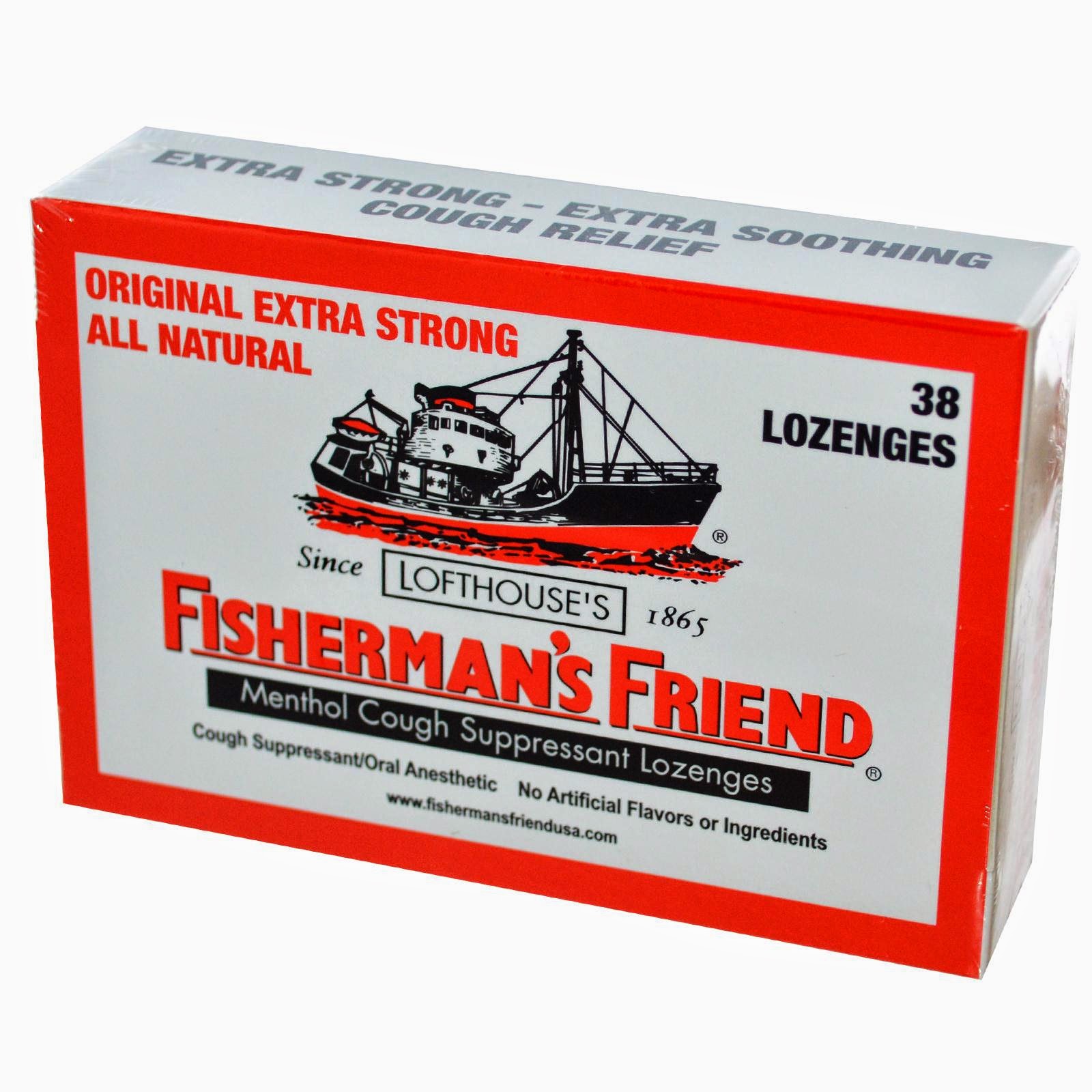 |
Developed in 1865, Lofthouse was looking to help fisherman with their seasonal colds. The lozenge contains menthol and eucalyptus, just like Halls, but much earlier. The fisherman liked them so much they called them their friend. Hence the name; they’re still sold today. Menthol drops can calm a cough, but menthol is also slightly analgesic, so some throat pain can be reduced by them as well. |
A 2013 study went further. It assessed the anti-tussive action of menthol in guinea pigs and showed that the effect on TRPM8 was only effective when it was in vapor form and when it was applied to the nasal passages. Menthol on trachea or throat TRPM8 had no effect on cough. So – when you use Halls cough drops, it's the vapors from the dissolving drops that go up your nose and help stop the cough – don’t chew on them and swallow! You put them in your mouth, but they don’t act there. But don’t stuff them up your nose either – did I need to say that?
We have considered TRPM8 in thermoregulation, nasal resistance, and cough. Next week, let’s show some funky functions for cold receptors – like how they can stop cancer or how they screw up opiate addiction withdrawal.
For more information or classroom activities, see:
Cold viruses –
nasal resistance –
menthol and cough –